
Search Michigan Criminal Records
Michigan criminal records are held across several state databases, county courts, and law enforcement systems. You can search felony convictions, court case records, corrections data, and sex offender registration information through free and low-cost tools maintained by Michigan state agencies. This guide walks you through each system so you can find what you need fast, whether you are looking up a name, a case number, or a specific court filing from any of Michigan's 83 counties.
Michigan Criminal Records Overview
Michigan Criminal Records Through ICHAT
The Internet Criminal History Access Tool (ICHAT) is the main public-facing database for Michigan criminal records. It is run by the Michigan State Police Criminal Justice Information Center. Under MCL 28.241, the Michigan State Police serve as the central repository for all criminal history records in the state, which is why ICHAT pulls from such a wide pool of data. Each search costs $10, paid by credit or debit card, and results come back right away. You do not need to create an account for a one-time search. Guest access is open to anyone.
ICHAT searches by name and date of birth. You enter the subject's full name along with their birth date, and the system checks against conviction data from courts across all 83 Michigan counties. Results include felony convictions, serious misdemeanor convictions, active warrants from participating agencies, and arrests pending prosecution within the last seven days. Each result shows the offense, the MCL citation, the date of conviction, the sentencing court, and the sentence imposed. You also get the subject's State Identification Number, which is the unique ID Michigan assigns to each person in the system.
ICHAT has clear limits. It does not include traffic offenses except DUI and OWI convictions. Juvenile records stay out of ICHAT unless the case was tried in adult court. Federal charges, out-of-state history, and arrests without convictions are not in the system. Records expunged under Michigan's Clean Slate law are also removed from ICHAT results. Keep in mind that ICHAT is name-based only. A positive match does not mean certain identification. Fingerprint-based checks are more definitive when accuracy matters most.
Note: ICHAT results are name-based and may return multiple people with similar names. Always verify results with additional identifiers before acting on the information.
OTIS Offender Search for Michigan Criminal Records
The Offender Tracking Information System (OTIS) is the Michigan Department of Corrections' public search tool. It is free to use. OTIS covers people who are currently in state prison, on parole, on probation under MDOC supervision, or who were discharged within the past three years. After three years from the discharge date, records come down from public view. If someone re-enters MDOC supervision, the three-year clock resets.
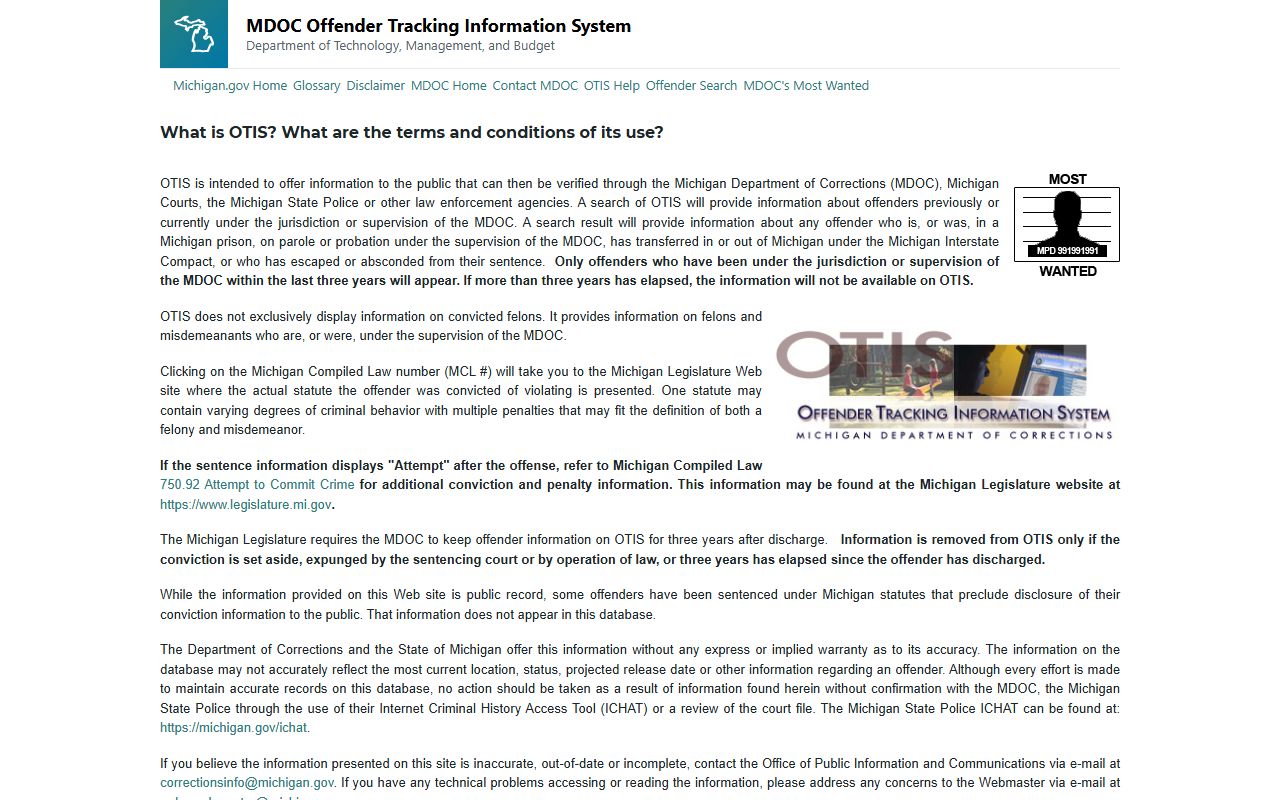
To search OTIS, you need at least a last name or an MDOC number. The MDOC number is the most accurate search method because it finds one specific person. Name searches can return multiple results. You can narrow them down using first name, gender, age range, or race. You can also use a wildcard by entering the first three or more characters of a name followed by an asterisk. For example, searching "Smi*" returns all names that start with those letters.
Each OTIS profile shows the person's full name, known aliases, date of birth, physical description, offense details, sentence length, county of conviction, and current supervision status. Status codes tell you exactly where the person stands: PRISON means currently incarcerated, PAROLE means released under parole supervision, PROB means on probation, DISCHRG means the sentence is done. There are also codes for escape (ESCAPE1 and ESCAPE2), abscond from parole (ABSCOND1), and abscond from probation (ABSCOND2). You can contact the Michigan Department of Corrections at correctionsinfo@michigan.gov if you have questions about a specific record.
Michigan Sex Offender Registry
The Michigan State Police maintain the Public Sex Offender Registry (PSOR). Access is free. The registry lists people who are required to register as sex offenders in Michigan, including those who live, work, or go to school here. You can search by name, by address or radius, by city, county, or zip code, by registration number, or through an interactive map. The map feature is useful if you want to check a specific neighborhood or area rather than looking up a particular name.
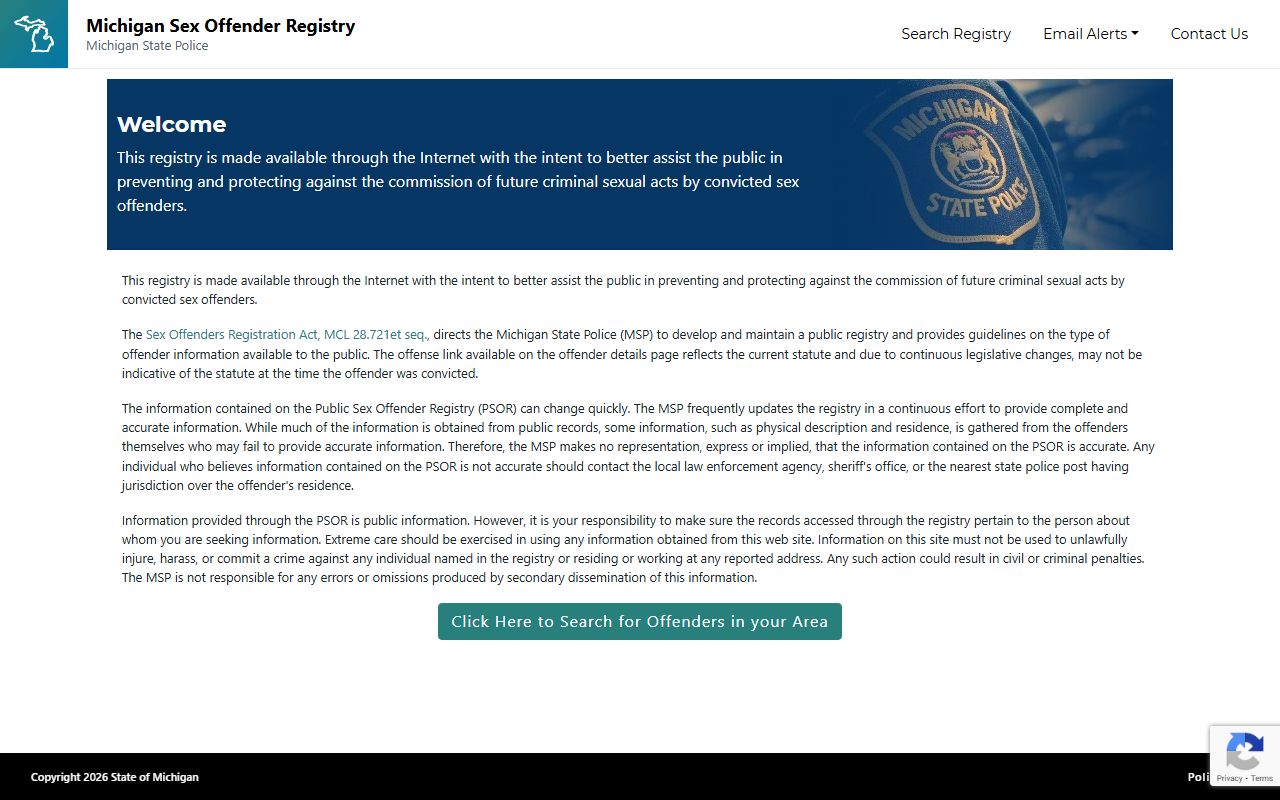
Michigan uses a three-tier registration system. Tier I covers less severe offenses and requires annual verification. Tier II is for moderate offenses, with verification every six months. Tier III is for the most serious offenses and requires quarterly check-ins. Each registry profile includes a photo, full name, aliases, physical description, current address, offense information, tier level, and compliance status. You can also see employment and school information where applicable. For questions, contact the Sex Offender Registry unit by phone at 517-241-7956 or by email at MSP-SOR@Michigan.gov.
MiCOURT Michigan Criminal Case Search
Michigan courts use MiCOURT as the statewide case management and public search system. Basic searches are free. MiCOURT covers the Michigan Supreme Court, Court of Appeals, circuit courts, district courts, and probate courts. Circuit courts handle felonies and major crimes. District courts handle misdemeanors and traffic cases. You can search by case number, party name, attorney name, court type, or date range.
A MiCOURT search gives you the case number, filing date, party names, case type, current status, scheduled hearings, the register of actions, judgment details, and any financial assessments. Document images are not always available online. Some case types are restricted, including juvenile cases, mental health cases, and personal protection orders. Michigan's Clean Slate law also affects what shows up. Records that have been automatically expunged under the law no longer appear in public searches. For court-level contact info and additional help, visit the Michigan Courts portal. Electronic filing for attorneys and parties is handled through MiFILE.
Michigan FOIA and Criminal Records Requests
When public databases do not have what you need, the Michigan Freedom of Information Act gives you a direct route to government-held records. Michigan's FOIA is codified under MCL 15.231. Any person can submit a written request to a public body for access to public records. You do not need to explain why you want them. Requests can go by mail, email, fax, or in person.
Once you submit a FOIA request, the agency has five business days to respond. The response can be a full grant, a partial grant, a denial with a stated statutory basis, or a notice extending the deadline by up to 10 more business days. Standard copy fees are $0.10 per page for black-and-white paper copies. Labor costs are billed at the hourly rate of the lowest-paid employee capable of doing the work. If the total fee is expected to exceed $50, the agency can require a 50% deposit before it starts processing. People with low incomes can get the first $20 of fees waived by submitting an affidavit.
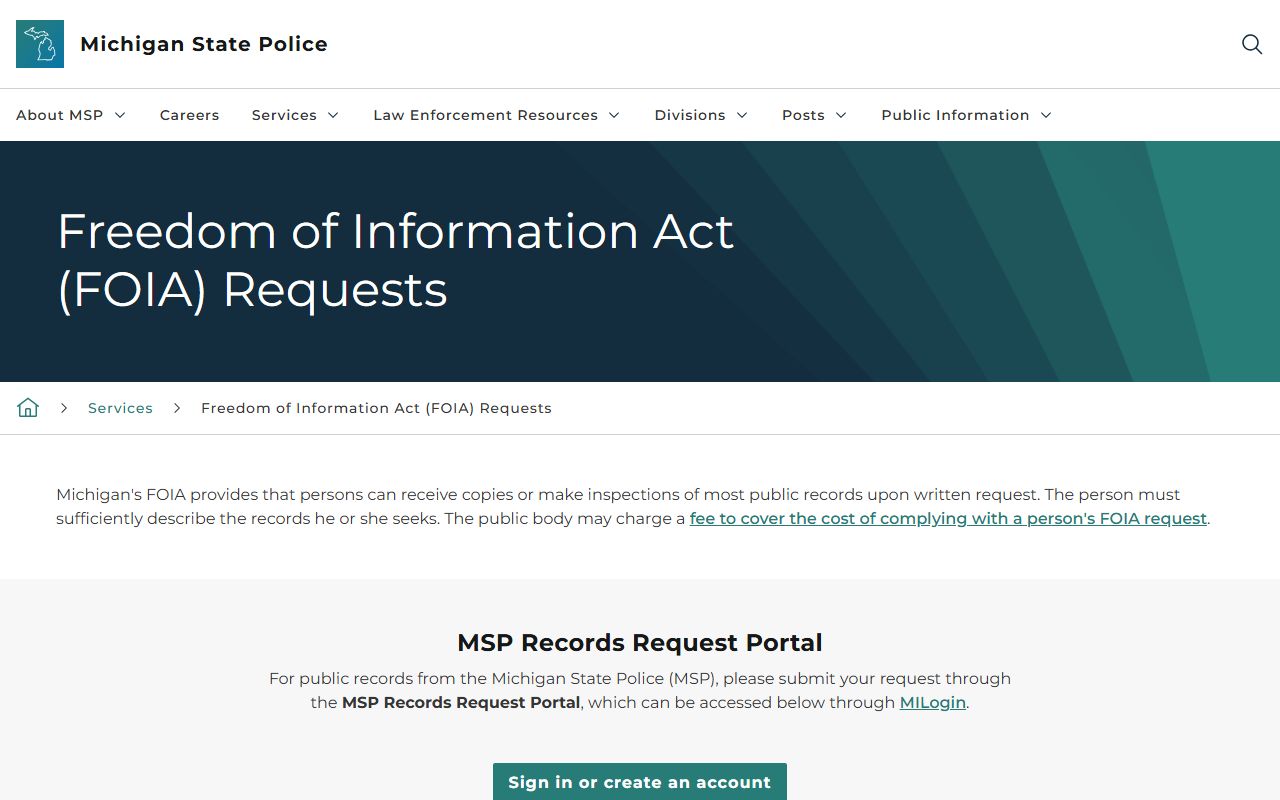
The Michigan State Police FOIA unit handles requests for MSP records, including incident reports, accident reports, and certain criminal history files. Their records request portal is at michigan.gov/msp/services/foia. You can also fax requests to 517-241-1935, call the Records Resource Section at 517-241-1934, or mail requests to: Michigan State Police, CJIC, FOIA Unit, 7150 Harris Drive, Dimondale, MI 48821. Note that exemptions under MCL 15.243 can block access to some law enforcement investigation records, personal privacy information, and security-sensitive data.
Michigan Clean Slate and Expungement
Michigan's Clean Slate law, passed under MCL 780.621, created automatic expungement for many criminal convictions. The law went into effect in April 2023. Under the automatic process, up to four misdemeanor convictions can be cleared after seven years with no new offenses. Up to two felony convictions can be cleared after ten years under the same conditions. First-degree murder, criminal sexual conduct, and most traffic offenses do not qualify. Once a record is expunged, it is removed from ICHAT results and public court databases.
For offenses that do not qualify for automatic expungement, Michigan still allows an application-based process. You file a petition in the court where you were convicted. The prosecutor gets a chance to object. A judge reviews the petition at a hearing and decides whether to grant it. The criteria for application-based expungement are broader than they used to be. Clean Slate expanded eligibility in ways that were not available under the old rules. If you think a record may have been expunged, an ICHAT search will reflect that. The record simply will not appear. This is one reason why ICHAT results can sometimes come back with no convictions even when you expected to find something.
Note: Automatic expungement under MCL 780.621 does not require any action from the person whose record is being cleared. The process runs through the courts automatically.
The Michigan Attorney General's consumer protection division handles complaints and some civil enforcement matters that intersect with fraud and criminal activity. You can access that resource at michigan.gov/ag/consumer-protection.
MSP Criminal History Records
Beyond ICHAT, the Michigan State Police Criminal History Records page explains the full scope of what MSP maintains under state law. Fingerprint-based background checks are available for authorized requesters, such as employers in certain industries, licensing boards, and law enforcement. These checks are more thorough than ICHAT because they tie directly to fingerprint records rather than name matches. They can also include FBI national criminal history checks in some cases.
The Michigan Department of Corrections also maintains its own public information resources through the MDOC website. MDOC handles prison management, parole, and probation across the state. Their site provides policy documents, inmate population data, and general corrections information. OTIS is the public-facing search tool that pulls from MDOC's offender database. Together, ICHAT and OTIS cover the two main categories of criminal records you are likely to search for in Michigan: conviction history and corrections status.
Browse Michigan Criminal Records by County
Michigan has 83 counties, each with its own circuit and district courts handling criminal cases. Select a county to find local court contact info and search options.
Michigan Criminal Records by City
Major Michigan cities are served by county courts. Find criminal records resources for your city below.